


If you’ve ever seen a piece of acrylic with perfectly clear, glass-like edges, there’s a good chance it’s been flame polished. Flame polishing is a finishing method used mainly on plastics such as acrylic to improve edge clarity, smoothness, and overall appearance. It’s widely used in fabrication, signage, retail displays, and high-end plastic components where visual quality matters.
This guide explains what flame polishing is, how it works, when to use it, and what you need to know before choosing it for your project.
What is flame polishing?
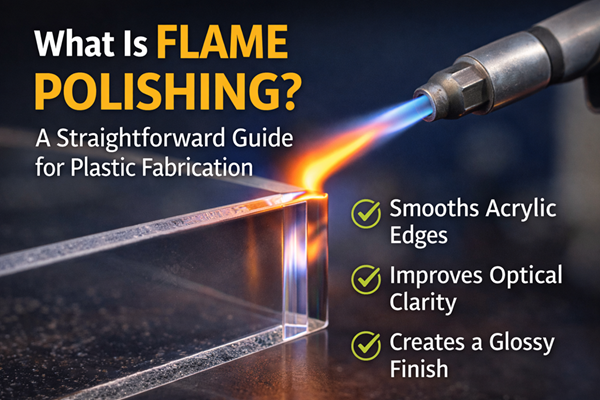
Flame polishing is the process of passing a controlled flame over the cut edge of a thermoplastic material, typically acrylic (also known as Perspex or PMMA). The heat from the flame briefly melts the surface of the plastic, allowing it to reflow and smooth itself out.
As the plastic cools almost instantly, it solidifies into a clear, glossy finish.
The result is:
- Smooth edges
- Improved optical clarity
- A professional, high-end appearance
- Removal of minor saw marks and surface imperfections
Unlike sanding or mechanical polishing, flame polishing relies on heat rather than abrasion.
Why flame polishing is used
When acrylic is cut with a saw, CNC router, or laser, the edges often appear frosted, dull, or slightly rough. Even precise cuts leave microscopic imperfections that scatter light and reduce clarity.
Flame polishing fixes this by restoring transparency and smoothness.
It’s commonly used for:
- Retail display cases
- Acrylic furniture
- Point-of-sale displays
- Protective screens
- Signage
- Museum and exhibition pieces
- Aquariums and enclosures
In any environment where appearance matters, flame polishing makes a visible difference.
How flame polishing works
The principle is simple, but execution requires skill and control.
A trained operator uses a gas torch, usually fuelled by hydrogen, propane, or oxyhydrogen, and moves the flame quickly and evenly across the acrylic edge.
The heat briefly melts only the outermost surface layer. Surface tension naturally smooths out the microscopic peaks and valleys. The plastic then cools within seconds, leaving a clear, polished edge.
The key factors are:
- Flame temperature
- Speed of movement
- Distance from the surface
- Material thickness
- Material quality
Too much heat causes bubbling, distortion, or stress damage. Too little heat achieves nothing.
This is why proper flame polishing techniques matter, it’s not something you can fake with guesswork.
Flame polishing vs other polishing methods
Flame polishing is just one of several finishing options. Each has its place.
Flame polishing
Best for: Clear acrylic, cosmetic finishes, straight edges
Result: High gloss, crystal-clear finish
Speed: Fast
Cost: Efficient for production work
Diamond polishing
Best for: Thick acrylic, structural applications
Result: Highest precision and clarity
Speed: Slower
Cost: Higher
Mechanical polishing (sanding and buffing)
Best for: Small parts, manual finishing
Result: Good finish but more labour-intensive
Speed: Slow
Cost: Labour-dependent
Flame polishing is often the most cost-effective solution when appearance is the priority and edges are accessible.
Advantages of flame polishing
There’s a reason it’s widely used in acrylic fabrication.
Excellent clarity
It restores near-original transparency to cut edges.
Fast process
It’s significantly quicker than manual polishing methods.
Cost-effective
Especially suitable for batch production and larger pieces.
Professional appearance
Creates clean, glossy edges that improve perceived quality.
Limitations and Risks
Flame polishing isn’t perfect in every situation.
Can introduce internal stress
Improper technique can create stress points that weaken the material over time.
Not ideal for load-bearing parts
If the acrylic will be structurally stressed, diamond polishing may be safer.
Requires skilled handling
Inexperienced operators can cause:
- Edge distortion
- Bubbles
- Surface crazing
- Permanent damage
Not suitable for all plastics
It works best on acrylic. Other plastics like polycarbonate do not respond the same way.
Where you’ll commonly see flame polished acrylic
You’ve probably seen flame polished acrylic without realising it.
Examples include:
- Shop display stands
- Cosmetic display units
- Protective barriers
- High-end signage
- Furniture components
- Award plaques
- Exhibition panels
That smooth, glass-like edge is usually the result of flame polishing.
Is flame polishing the right choice for your project?
It depends on your priorities.
Flame polishing is ideal if you want:
- Maximum visual clarity
- Smooth, glossy edges
- Fast turnaround
- Cost-efficient finishing
It may not be the best option if:
- The part is structural or load-bearing
- Precision tolerances are critical
- Internal stress must be minimised
In those cases, diamond polishing is often preferred.
Final thoughts
Flame polishing is one of the most effective ways to improve the appearance of acrylic. It transforms rough, dull edges into smooth, crystal-clear surfaces that look professional and high-quality.
When done correctly, it’s fast, efficient, and delivers excellent results. However, it requires proper equipment and skilled handling to avoid damaging the material.
If you work with acrylic regularly, whether in signage, fabrication, retail displays, or manufacturing, understanding flame polishing helps you choose the right finish for both performance and presentation.