

Acrylic is one of the most versatile plastics available. You’ll see it everywhere, from retail displays and protective screens to signage and bespoke fabricated components. But acrylic isn’t just cut and used flat. Through bending and moulding, it can be shaped into strong, seamless forms that look clean, professional, and built to last.
If you’re considering acrylic fabrication for your next project, understanding how bending and moulding works will help you decide whether it’s the right solution, and when it offers clear advantages over alternatives.
What is acrylic bending?
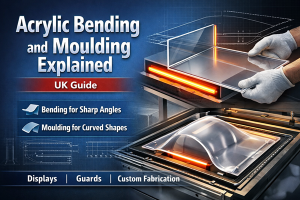
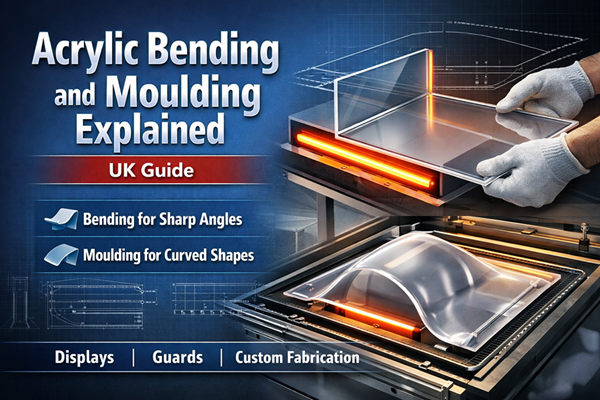
Acrylic bending is the process of heating a sheet of acrylic along a specific line until it becomes pliable. Once softened, the material is carefully bent to the desired angle and held in place while it cools and hardens.
This method is often called line bending or strip heating, and it allows fabricators to create precise angles without cutting and joining separate pieces.
How the process works:
- Heating – A controlled heat source warms a narrow section of the acrylic sheet.
- Softening – The acrylic becomes flexible at around 150–160°C.
- Forming – The softened section is bent to the required angle or shape.
- Cooling – The acrylic cools and retains the new form permanently.
Because the bend is formed from a single piece, the result is stronger, cleaner, and more visually appealing than glued joins.
What is acrylic moulding?
Acrylic moulding takes shaping a step further. Instead of bending along a straight line, the entire sheet is heated and formed over or into a mould to create more complex shapes.
This process is often referred to as thermoforming or vacuum forming, depending on the method used.
How moulding works:
- Heating the full sheet until it becomes flexible.
- Positioning over a mould that represents the final shape.
- Forming the acrylic using gravity, pressure, or vacuum.
- Cooling and trimming to achieve the finished component.
This allows for curved surfaces, contours, and three-dimensional forms that can’t be achieved through bending alone.
Key benefits of acrylic bending and moulding
These techniques offer several advantages over traditional fabrication methods.
1. Seamless, professional appearance
Because bends are formed from a single sheet, there are no visible joints, seams, or glue lines.
2. Excellent structural strength
A continuous piece of acrylic maintains its integrity better than bonded sections, reducing weak points.
3. Greater design flexibility
From simple right angles to complex curves, acrylic can be shaped to suit almost any design requirement.
4. Lightweight but durable
Acrylic is significantly lighter than glass, yet strong enough for demanding commercial and industrial use.
5. Cost-effective for custom work
Bending and moulding often reduce the need for multiple components, simplifying manufacturing and assembly.
When to choose acrylic bending
Acrylic bending is ideal when your project requires clean angles or structural forms made from flat sheet.
Common applications include:
- Retail display stands
- Protective machine guards
- Point-of-sale units
- Menu holders and leaflet displays
- Equipment covers
- Light diffusers and housings
If your design involves straight folds or angled shapes, bending is usually the most efficient and cost-effective option.
When to choose acrylic moulding
Moulding is the better choice when your design requires curves, contours, or complex shapes.
Typical uses include:
- Protective covers with curved surfaces
- Medical and laboratory equipment housings
- Automotive components
- Custom enclosures
- Architectural features
- Bespoke product displays
If your project can’t be achieved using flat sheets or straight bends, moulding opens up far greater possibilities.
Acrylic vs other materials
Many businesses consider glass, metal, or polycarbonate for similar applications. Acrylic often provides a better balance of performance and practicality.
Compared with glass:
- Much lighter
- More impact resistant
- Easier to fabricate
- Safer if damaged
Compared with metal:
- Better visual clarity
- Corrosion resistant
- Lighter weight
- More cost-effective for display applications
Precision matters in acrylic fabrication
The quality of acrylic bending and moulding depends heavily on the skill and equipment used. Poor temperature control or rushed handling can lead to stress marks, distortion, or weakened areas.
Professional fabrication ensures:
- Accurate angles and dimensions
- Smooth, bubble-free finishes
- Long-term durability
- Consistent quality across multiple components
This is especially important for commercial environments, where appearance and reliability directly affect brand perception and operational performance.
Is acrylic bending or moulding right for your project?
If your design requires:
- Clean angles → Choose bending
- Curves or complex forms → Choose moulding
- Strong, seamless construction → Both methods excel
- Professional visual finish → Acrylic is one of the best materials available
For retail, industrial, medical, or commercial applications, acrylic fabrication offers a flexible, durable, and visually impressive solution.
Working with experienced specialists like Denny Plastics ensures your acrylic components are manufactured precisely to specification, delivering both performance and presentation.