

Every acrylic project starts with the same decision, even if it is not always obvious at the time. Do you order a sheet cut to your dimensions and take it from there, or do you hand the whole job to a fabricator and receive a finished piece? Both routes are legitimate. Both save money in the right circumstances and waste it in the wrong ones. The trick is knowing which situation you are actually in.
This guide sets out the practical differences so you can make that call with confidence, whether you are ordering a single replacement panel or specifying components for a commercial fit-out.
What cut-to-size ordering actually gives you
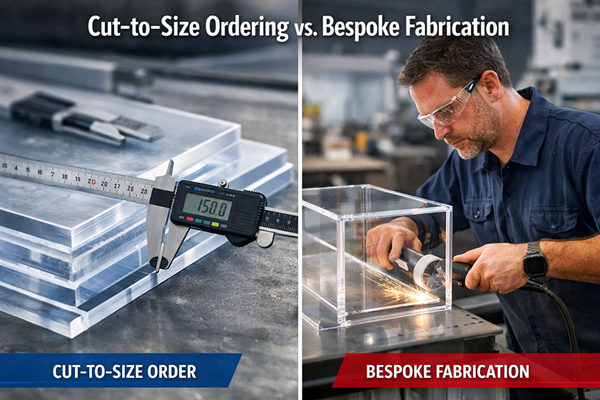
Cut to size means exactly what it says. You choose the material, the thickness and the dimensions, and the sheet arrives ready to install or use as-is. No shaping, no edge finishing beyond a basic cut, no additional processing.
It suits jobs where the geometry is simple and the installation is something you or your team can manage directly. A replacement greenhouse panel, a flat shelf insert, a protective cover for a piece of equipment, a sign blank that will be printed or vinyl-wrapped afterwards. In each case, the sheet is the finished product, or close enough to it that no further fabrication is needed.
The appeal is speed and cost. There is no design consultation, no tooling, and in most cases no wait for production capacity. You specify the thickness, the sheet is cut, and it is on its way.
Where cut to size falls short is anywhere the project needs more than a flat panel. Curved edges, mounting holes in precise positions, multiple pieces that need to align perfectly, or a finish beyond a standard cut edge, none of that is included, and trying to add it yourself on site is usually where problems start.
What bespoke fabrication adds
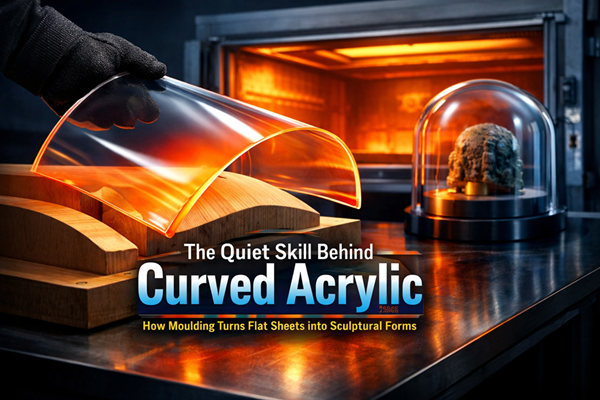
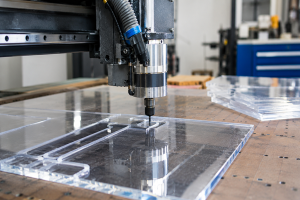
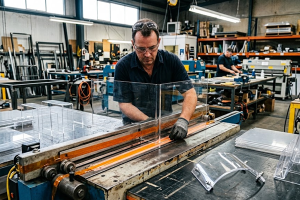
Bespoke fabrication is the full service. A fabricator takes your brief, whether that is a sketch, a set of drawings or simply a description of what you need, and produces a finished component or assembly. This is where processes such as CNC routing, laser cutting and engraving, bending, moulding and edge finishing come into play, often several of them combined in a single piece.
This is the route for anything where the acrylic needs to be shaped, joined, polished or built into an assembly. Perspex showcases and display cases, bespoke furniture, exhibition and retail displays, machine guarding built to fit a specific piece of equipment. These jobs depend on accurate measurement, correct material selection and finishing that a standard cut sheet cannot provide.
The trade-off is time and cost. Bespoke work involves design input, production scheduling and skilled labour, so it takes longer to turn around and costs more per piece than a straightforward sheet order. For a one-off, complex item, that cost is justified. For something simple, it is money spent on a service you did not need.
Questions that settle the decision
Rather than working through every possible scenario, ask these in order. The first one that applies to your project usually settles the matter.
Does the finished piece need to be anything other than flat? If yes, you need bending, moulding or another shaping process, which means bespoke fabrication.
Does it need to be joined to another piece of acrylic or another material? Joining work falls under bonding services, which is fabrication territory, not something achieved with a cut sheet alone.
Will the edges be visible in the finished installation? A cut edge is functional but has a frosted, unfinished appearance. If clarity matters, for example on a display case or piece of furniture, you will want flame polishing or diamond edge polishing, both of which are fabrication add-ons rather than part of a standard cut-to-size order.
Do you have the tools and confidence to drill, cut or fix the material yourself once it arrives? If the answer is no, and the project needs any of that, a fabricator should be doing it under controlled conditions rather than leaving it to on-site guesswork.
Is this a one-off or part of a repeat order? Businesses ordering the same flat panel repeatedly, such as trade buyers sourcing sheet material in bulk, are usually well served by cut to size and a trade account. A single complex piece rarely benefits from that approach.
If none of the shaping, joining or finishing questions apply, cut to size is very likely the right answer, and there is no reason to pay for a fabrication service you do not need.
Where people get this wrong
The most common mistake is ordering a flat sheet for a job that actually needs shaping, then discovering on site that acrylic cannot simply be bent by hand without cracking or losing clarity. The second most common mistake runs the other way: commissioning full bespoke fabrication for something that was always going to be a flat panel, and paying a premium for a service that added nothing to the finished result.
Both mistakes come from the same root cause, not being clear about what the finished piece actually needs to do before placing the order. A few minutes working through the questions above, or a short conversation with a fabricator before committing, avoids both.
Getting it right from the start
If you are still unsure which route suits your project, the safest approach is to describe what the finished piece needs to achieve, rather than the material you think you need. A fabricator can tell you quickly whether a cut sheet will do the job or whether shaping and finishing are required, and can quote accordingly. Denny Plastics offers both routes under one roof, from straightforward sheet sales through to complete bespoke fabrication. If you are weighing up which is right for your next project, get in touch and we will point you towards the option that actually fits the brief.