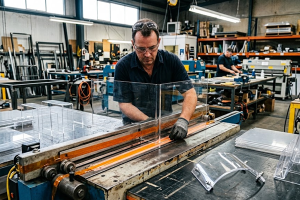


Plastic fabrication is the process of turning plastic sheet, tube or other stock material into a finished component or product. Depending on what the project requires, this can involve cutting, machining, bending, moulding, drilling, bonding, polishing or several processes used together.
It is an important part of manufacturing for businesses that need plastic components made to specific dimensions rather than relying on an off-the-shelf product.
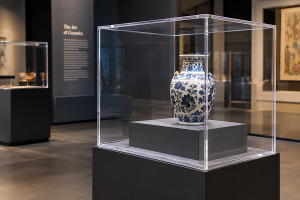
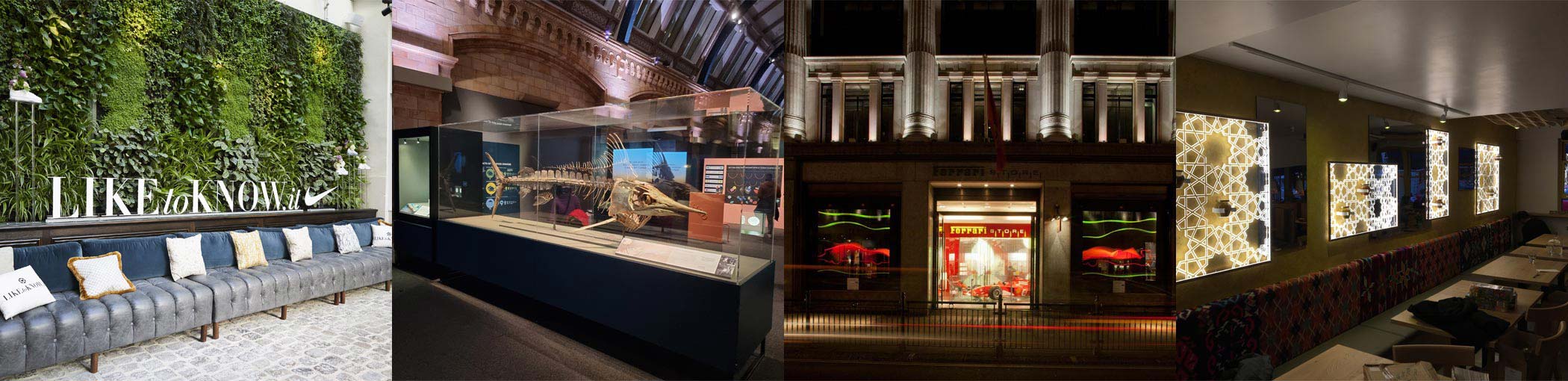
Plastic fabrication is used across a wide range of industries, including retail, manufacturing, engineering, museums, exhibitions, construction and interior design. The finished product could be something as straightforward as a precisely cut panel or as specialised as a large Perspex display case with polished edges and optically clear joints.
The right fabrication process depends on the material, dimensions, shape, quantity, finish and intended use of the finished component.
What is plastic fabrication?
Plastic fabrication involves manufacturing a product or component from plastic material using one or more specialist processes.
Unlike simply buying a sheet of plastic and cutting it to size, fabrication allows the material to be altered to meet a particular design or functional requirement.
For example, a project might require:
- A sheet cut to an unusual shape
- Precisely positioned holes or apertures
- A plastic component bent to a particular angle
- A curved or three-dimensional form
- Several pieces bonded together
- Polished edges
- A completely bespoke enclosure or display
These requirements can normally be achieved by combining different fabrication techniques.
This is why plastic fabrication is better thought of as a range of manufacturing processes rather than one particular method.
For projects that require several processes, our bespoke plastic fabrication service can take the project from the initial requirements through to the finished component.
Which plastics can be fabricated?
The choice of material is one of the first decisions to make because different plastics behave differently during cutting, machining, bending and forming.
Common materials used in plastic fabrication include:
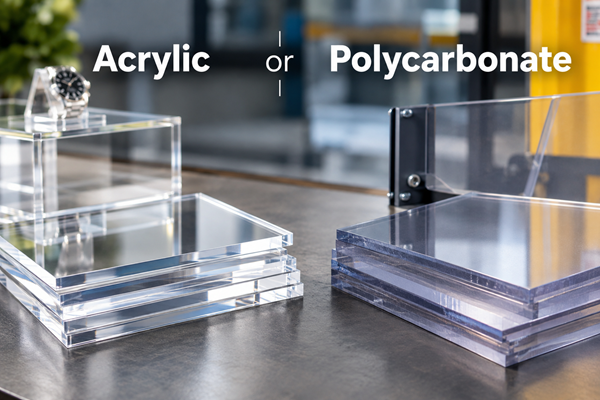
Acrylic and Perspex
Acrylic is widely used where appearance, transparency and a clean finish are important. It is particularly common in retail displays, signage, protective screens, furniture, showcases and architectural features.
Perspex is a well-known brand of acrylic sheeting and is available in a wide range of colours, finishes and thicknesses.
For projects where the finished component needs to look as good as it performs, acrylic can be particularly suitable because its edges can also be polished to produce a clear, high-quality finish.
Polycarbonate
Polycarbonate is known for its high impact resistance and is often selected for protective applications where the material may be subjected to knocks or impacts.
It can be machined and fabricated into components such as protective guards, screens and industrial parts.
The choice between acrylic and polycarbonate should be based on the requirements of the finished product rather than appearance alone. Our guide to acrylic and polycarbonate explains the practical differences between the two materials.
PVC and other engineering plastics
PVC and other plastics can also be fabricated for specific applications. The appropriate material depends on factors such as chemical exposure, temperature, strength, flexibility, appearance and the environment in which the finished component will be used.
A fabricator can help determine which material is suitable when the requirements are not clear at the design stage.
The main plastic fabrication processes
Plastic fabrication rarely relies on one process alone. A bespoke component might be cut from sheet, routed to its final dimensions, bent into shape and then polished or bonded.
The main processes include the following.
Plastic cutting
Cutting is one of the simplest forms of plastic fabrication, but achieving an accurate finished component requires the right cutting method for the material and design.
Straight cuts can be produced using conventional cutting equipment, while more complicated profiles may require CNC routing or laser cutting.
The thickness of the material, complexity of the shape, required tolerances and finish all influence which method is appropriate.
For straightforward requirements, plastic cutting can provide accurately sized components without the need for more complicated fabrication.
CNC routing
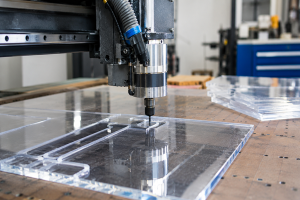
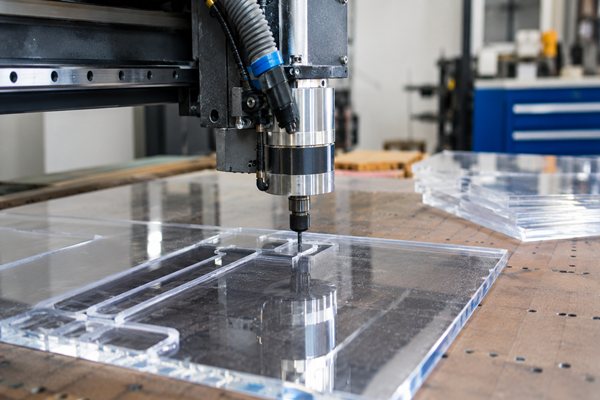
CNC routing uses computer-controlled machinery to cut, shape, drill and machine plastic according to a digital design.
It is particularly useful when a component contains complex profiles, apertures, holes, slots or other features that need to be positioned accurately.
It is also valuable when multiple identical components are required because the same digital cutting information can be used repeatedly.
Our CNC router has a 3,000mm x 2,000mm working area and can process materials including acrylic, polycarbonate, Perspex, Plexiglas, Foamex and Dibond. Read more about CNC routing for plastics.
CNC routing is often a good choice when a project involves:
- Complex profiles
- Large plastic sheets
- Repeated components
- Accurate cut-outs
- Holes and apertures
- Recesses and channels
- Components manufactured from CAD drawings
Laser cutting and engraving
Laser cutting is another option for producing intricate shapes from suitable plastic materials.
A laser can follow a digital design to create detailed profiles and small features with a high degree of accuracy. Laser engraving can also be used where text, logos or other markings need to be added to a component.
This makes the process particularly useful for signage, displays, branded components and detailed decorative work.
We provide laser cutting and engraving for projects where intricate cutting or engraving is required.
The best choice between CNC routing and laser cutting depends on the material, thickness, geometry and finish required.
Plastic bending and line bending
Plastic does not always need to be cut into separate pieces to create a three-dimensional product.
Thermoplastics such as acrylic can be heated until they become pliable and then formed into a new shape.
Line bending, sometimes called strip heating, concentrates heat along a particular section of the sheet. Once the material becomes flexible, it can be bent to the required angle and held in position while it cools.
The result is a continuous piece of material rather than two separate pieces joined together.
This is useful for products such as:
- Display stands
- Leaflet holders
- Protective covers
- Point-of-sale units
- Equipment housings
- Retail fixtures
- Bespoke boxes and enclosures
We have a 3m-long line bender, allowing longer straight bends to be produced. Our bending service can be used where a project requires accurately formed acrylic components.
Plastic moulding
Moulding is used when a project requires a shape that cannot be achieved through a simple straight bend.
The plastic sheet is heated until it becomes pliable and then formed over or around a former to create the required shape.
The process can be used to produce curved surfaces, large-radius forms and other three-dimensional components.
We use a 2440mm x 1220mm moulding oven to heat and form large acrylic sheets. The material can then be placed into timber formers and allowed to cool into the required shape. Find out more about acrylic moulding.
Moulding can be particularly useful for:
- Curved covers
- Cylindrical components
- Bespoke display pieces
- Large-radius forms
- Protective housings
- Architectural features
The required shape, material thickness and size of the component all need to be considered before production begins.
Drilling and machining
Plastic components often require more than an external profile.
Holes, slots, recesses and other machined features may be necessary for fixing, assembly or integration with another component.
CNC routing can incorporate many of these features into the same manufacturing process, which can be useful when accuracy and repeatability are important.
The location and size of holes should ideally be established during the design stage rather than added as an afterthought. This helps the fabricator select the most appropriate machining method and reduces the risk of damaging the finished component.
Bonding and assembly
Some plastic products consist of several individual components that need to be joined together.
Plastic bonding can create a strong and visually clean connection when the correct adhesive and preparation method are used.
The choice of bonding method depends on the plastic, joint design, application and appearance required.
Bonding is commonly used when manufacturing:
- Boxes
- Display cases
- Enclosures
- Retail displays
- Covers
- Bespoke furniture
- Multi-part assemblies
We offer plastic bonding as part of its fabrication capabilities.
For applications where the joint will be visible, the fabrication method needs to be considered alongside the desired finish. A technically sound joint is not necessarily the right choice if the finished product needs to have a virtually invisible connection.
Polishing and finishing
Fabrication does not necessarily end when the plastic has been cut and assembled.
The edges of acrylic can be finished in different ways depending on the appearance required.
A standard cut edge may be sufficient for some industrial components, while a display, showcase or piece of bespoke furniture may require a highly polished edge.
We use several finishing techniques, including diamond edge polishing, flame polishing and hand buffing. These can produce different results depending on the material, thickness and application.
For example, a highly polished edge can make a clear acrylic component look considerably more refined, which can be important for retail displays, furniture and museum showcases.
How to choose the right plastic fabrication process
There is no single plastic fabrication process that is suitable for every project.
The most appropriate method depends on several factors.
1. What does the finished component need to do?
Start with the function rather than the manufacturing process.
Does the component need to protect machinery? Display a product? Fit around an existing structure? Hold another component in place? Create a particular visual effect?
The answer will help determine the material and fabrication method.
2. What shape is required?
A flat panel may only require cutting.
A component with holes and detailed profiles may benefit from CNC routing.
A folded product could require line bending.
A complex curved form may require moulding.
The more complicated the geometry becomes, the more important it is to involve the fabricator early in the process.
3. Which material is appropriate?
Acrylic may be suitable when clarity and appearance are important, while polycarbonate can be preferable when impact resistance is a major consideration.
Material selection also affects how easily the finished component can be cut, bent, machined, bonded and polished.
For this reason, it is worth discussing the material before finalising the manufacturing process.
4. How many components are required?
The best process for a one-off component is not necessarily the most efficient process for several hundred identical parts.
For repeat production, consistency and repeatability become increasingly important. Digital manufacturing methods such as CNC routing can be particularly useful when the same component needs to be produced repeatedly.
5. What finish is required?
The finished appearance should be considered before fabrication begins.
A component may require:
- Clear polished edges
- A specific colour
- Engraving
- Smooth surfaces
- Visible or concealed joints
- A particular level of transparency
These requirements can influence both the material and the fabrication process.
When is bespoke plastic fabrication the right choice?
Bespoke fabrication makes sense when an existing product does not meet the requirements of the project.
This could be because the required dimensions are unusual, the component needs a specific shape, several parts need to work together or the finished product needs to meet a particular visual or technical specification.
Typical examples include:
Retail and point-of-sale
Plastic fabrication can be used to create product stands, shelves, holders, signage, display units and other retail components.
Museums and exhibitions
Acrylic is frequently used for showcases, protective cases and display components where visibility is important.
We manufacture Perspex showcases and display cases for museums, galleries and exhibitions.
Manufacturing and engineering
Fabricated plastic components can be used for machine guards, covers, protective panels, equipment housings and other bespoke parts.
Furniture and interiors
Acrylic can be cut, bent, polished and assembled to create bespoke furniture and interior features.
We also provides bespoke perspex furniture for projects where standard furniture does not provide the required dimensions or appearance.
Exhibitions and events
Exhibition stands often require lightweight, visually striking components that can be produced to precise dimensions and assembled as part of a wider installation.
We provide exhibition and retail display fabrication for these types of applications.
What should you provide to a plastic fabricator?
The more information available at the beginning of a project, the easier it is to establish the right material and manufacturing process.
Ideally, provide:
- The dimensions of the finished component
- A drawing or CAD file if available
- The material you are considering
- The required thickness
- The quantity required
- Any holes, cut-outs or fixing points
- The required finish
- How the component will be used
- Where it will be installed
- Any relevant environmental conditions
- Your required timescale
You do not necessarily need to know the exact fabrication process before contacting a specialist.
In fact, it can be better to explain what you need the finished product to achieve and allow an experienced fabricator to recommend the most suitable combination of material and processes.
Why use a specialist plastic fabricator?
Plastic fabrication can look straightforward from the outside. A sheet is cut, heated or joined and turned into a finished product.
In practice, the quality of the result depends on much more than the machinery being used.
Material behaviour, tolerances, heat control, tooling, finishing techniques and assembly all affect the finished component.
An experienced fabricator can also identify problems before production begins. A design that looks suitable on a screen may need changes to account for material thickness, bend radius, fixing points or the way separate components will be assembled.
This is particularly important for bespoke projects because correcting a design after production has started can be considerably more expensive than addressing the issue beforehand.
Plastic fabrication from design to finished product
Plastic fabrication covers a broad range of processes, from straightforward cutting through to complex moulding and multi-part assembly.
The most suitable approach depends on the job rather than the name of the material alone. A successful project starts by considering the finished application, then working backwards through the material, dimensions, manufacturing process and required finish.
For businesses requiring a single bespoke component, a production run or a complete fabricated plastic product, we can combine different fabrication techniques within the same project.
With capabilities including CNC routing, laser cutting and engraving, bending, moulding, cutting, bonding and specialist polishing, the fabrication process can be matched to the requirements of the finished product. If you have a drawing, specification or simply an idea for a plastic component, contact us to discuss the project and determine the most suitable way to manufacture it.