


Acrylic has become one of the most versatile materials on the fabrication floor, and a large part of that versatility comes down to how it can be shaped without cutting it into pieces. Line bending is the process that makes this possible, and it has quietly become a go-to technique for businesses that need strong, seamless acrylic units rather than components glued together after the fact.
This post looks at what line bending actually involves, where it is used across retail, manufacturing and display work, and why so many buyers specify it over other joining methods.
What line bending actually does
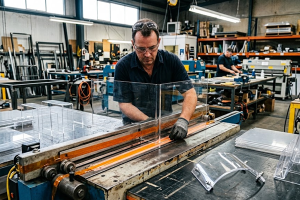
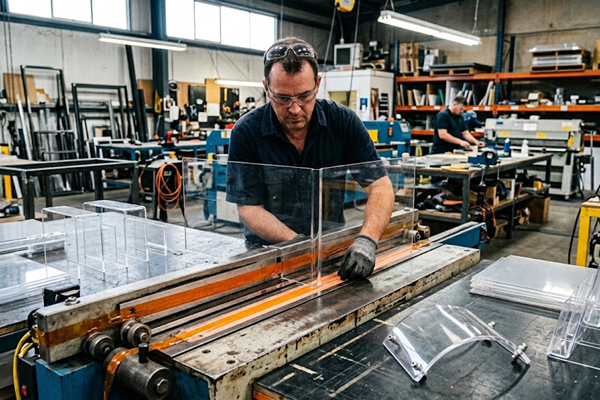
Line bending uses a heated element to soften a straight section of acrylic sheet, allowing it to be folded along a single line while the rest of the sheet stays rigid. Once the material cools, the bend holds permanently, with no seam, no adhesive and no visible joint. A single sheet up to several metres long can be folded into an L-shape, a U-shape, or a more complex multi-fold form, depending on how many bends are needed and how the sheet is positioned on the machine.
The practical benefit is straightforward: a unit that would normally require two or three separate panels bonded together can instead be made from one continuous piece. Fewer joints mean fewer weak points, a cleaner finish and, in most cases, a faster turnaround.
Retail: Point of sale and in-store fixtures
Retail is where line bending sees the heaviest use. Shop fittings live under constant handling, so anything with a bonded seam is a point of failure waiting to happen. Line-bent acrylic solves this for a wide range of in-store items:
- Plinths and product risers, where a folded base gives a raised platform without a visible join at the corner
- Leaflet holders and literature dispensers, which need a clean pocket shape that a bonded box cannot replicate as neatly
- Till-point and counter displays, produced in runs from single units up to several thousand
- Shelf edging and signage brackets, where a consistent fold angle matters for how the fixture sits against a shelf or wall
Retailers tend to order these in volume, and line bending suits that. Once a bend profile is set on the machine, it can be repeated accurately across a production run, which keeps unit costs down and every piece consistent. For businesses working on wider fit-outs, this pairs naturally with dedicated exhibition and retail display fabrication, where bent components often form part of a larger stand or display system.
Manufacturing: Guards, enclosures and functional parts
Outside of retail, manufacturers use line-bent acrylic wherever a lightweight, corrosion-resistant alternative to metal is needed. Machine guards, control panel covers and equipment housings are common examples, since a folded acrylic guard offers clear visibility of the machinery behind it while still providing a physical barrier.
Line bending also suits functional enclosures for electronics and instrumentation, where a single folded shell is more resistant to flexing and cracking than a bonded box, particularly around the corners. In production environments where parts are handled repeatedly, that structural advantage over time reduces returns and reworking.
Displays: Museum, gallery and exhibition work
Museums, galleries and exhibition organisers have their own reasons for choosing line bending, and durability is only part of it. A folded acrylic case has fewer visible lines than a bonded one, which matters when the display itself should not distract from what is inside it. This is why line-bent acrylic turns up frequently in showcase work, alongside more specialist bonded joints used for larger or more complex cases.
Exhibition stands benefit for a different reason: speed of build and take-down. A single folded panel is easier to transport, assemble and dismantle than a multi-part bonded structure, which matters for stands that get erected and struck down repeatedly across a touring schedule.
Why choose line bending over bonding
The decision between line bending and bonding usually comes down to three factors:
- Strength. A bent corner has no glue line, so there is nothing to fail under stress, vibration or repeated handling.
- Appearance. Without a bonded seam, the finished piece has a cleaner, more professional look, which matters for anything customer-facing.
- Cost at volume. For runs of identical items, a set bending profile is quicker to replicate than manually bonding each unit, which brings the per-item cost down.
Bonding still has its place, particularly for larger or irregular forms where a single sheet cannot achieve the required shape. In practice, most fabricators use a combination of both techniques depending on the design.
Getting the right fabrication partner
Line bending sounds simple in principle, but consistent results depend on the equipment used and the experience of the person operating it. Sheet length, thickness and the tightness of the bend radius all affect how the material behaves under heat, and getting any of these wrong can leave a visible stress mark or an uneven fold. Working with a fabricator who runs line bending regularly, rather than as an occasional job, is generally the safest way to get a result that holds up in daily use. If you are specifying acrylic components for a retail fit-out, a production run or an exhibition build, it is worth discussing the bend requirements with your fabricator early. Getting the fold profile right at the design stage avoids costly changes further down the line.